



 18d $6,360 China, End to End
  5d $1,430 Above the Pillars, Then Below
  3d $840 After the Last Booth
  13d $3,500 All the Way West
  12d $4,060 Axis to Kitchen Table
 Xi'an is China's ancient capital because it was Chang'an — the seat of 13 dynasties across more than a thousand years, and the eastern origin of the Silk Road. Plan two to three days: the Terracotta Warriors take a half-day, the 14 km Ming city wall and the Muslim Quarter take another, and the third is what turns a monument tour into a trip.
Beijing usually takes the spotlight as China's imperial city. But the Forbidden City dates from the Ming dynasty — comparatively recent. Xi'an was already the centre of the Chinese world a thousand years earlier, when Chang'an was arguably the largest and most cosmopolitan city on earth, the place where Central Asian traders, Buddhist monks and Persian diplomats ended their journey east.
What makes Xi'an unusual today is that the ancient layer and the ordinary one sit on top of each other. You can touch a six-hundred-year-old rampart in the morning and drink a flat white in a plane-tree-lined lane in the afternoon, twenty minutes apart. This guide is written for that trip: what the ancient-capital legacy actually left you to see, what deserves your limited days, and where the famous Army fits into a balanced visit rather than swallowing it.
Key Takeaways
- Chang'an, not Xi'an, is the name that explains the city. Thirteen dynasties ruled from here, including the Han and the Tang — the two golden ages of Chinese art, poetry and international exchange. - The Terracotta Warriors are the flagship but not the trip. Budget a half-day, treat them as one of four or five major experiences, and you'll leave with a far better impression of the city. - The 14 km city wall is the most underrated sight in Xi'an. It's one of the few complete old-town ramparts left in China, and you can cycle the entire circuit. - Xi'an is a Silk Road food city, not a generic Chinese one — wheat noodles, lamb, cumin and flatbread rather than rice and delicate stir-fries. - Two to three days is the sweet spot. One day covers the old town only; a fourth makes sense only for a day trip or if you're continuing west. - Spring (April–May) and autumn (September–October) are the seasons to target. Summer regularly runs 35–40°C and makes the outdoor sights punishing. - Book major sites in advance under your real name. The Terracotta Warriors and the Shaanxi History Museum both use timed, ID-linked reservations that sell out in peak season.
Why Is Xi'an Called China's Ancient Capital?
Because for more than a thousand years it was the capital — under the name Chang'an, for thirteen dynasties including the Zhou, Qin, Han, Sui and Tang. No other Chinese city held the centre of power for so long, and none absorbed as much of the outside world while doing it.
The Silk Road is the reason the second half matters. Chang'an was the eastern terminus, which meant the city was not merely powerful but genuinely foreign-facing: Sogdian merchants, Nestorian Christians, Persian musicians and Japanese envoys all lived here. Tang-dynasty Chang'an was laid out on a strict grid inside walls that enclosed an area several times larger than the old town you can walk today, and at its height it may have been the biggest city in the world.
That history is why Xi'an feels different from Beijing. Beijing shows you the last imperial act — a court, a wall, a summer retreat, all Ming and Qing. Xi'an shows you the foundations underneath: the first emperor's buried army, Han tombs, Tang pagodas built to house scriptures carried back from India. The scale of time is the attraction.
The modern city is more relaxed than that reputation suggests. Xi'an is a provincial capital of several million people with a young student population, a good coffee scene and an unhurried pace. Visitors who plan only monuments are often surprised by how pleasant the ordinary streets are.
Is Xi'an Worth More Than Two Days?
Yes, if you care about history and food; two days is workable but tight, and three is where the city stops feeling like a checklist. If you want landscapes, nightlife or modern skylines, Xi'an is a shorter stop and that's a reasonable call.
The honest case for three days is that Xi'an's attractions are unusually spread across categories. The Warriors are archaeology. The wall is an activity. The Muslim Quarter is a meal. The Shaanxi History Museum is a serious museum that needs two hours to do anything but skim. The Tang-dynasty pagoda district is an evening. Compress those into two days and you spend the trip in transit between them.
The counter-case, stated fairly: Xi'an is history-first, and if dynasties and archaeology aren't your thing, the city itself can read as an ordinary large Chinese city with excellent food. Parts of it are poorly served by the metro, leaving you dependent on ride-hailing. If your entire China trip is one week, Beijing and Shanghai will usually earn the two slots ahead of it — add Xi'an from about ten days onward. On a longer trip, though, it's the city that gives the rest of what you see its historical footing.
Which Xi'an Traveller Are You?
Xi'an rewards a focused trip more than a comprehensive one. Pick a spine, then flex around the weather and your energy.
| You are a… | Prioritise | Best base | Go easy on |
|---|---|---|---|
| History-first traveller | Terracotta Warriors with a guide, Shaanxi History Museum, Stele Forest, Han Yang Ling | Inside the walls, near the Bell Tower | Packing the evenings too — the daytime sites are already dense |
| Food traveller | Muslim Quarter side lanes, Yongxingfang, a Biang Biang noodle hunt, the Wumu Gate morning market | Bell Tower / Drum Tower | The main tourist food drag; walk one lane over |
| Family with children | Cycling the wall, Tang Paradise after dark, a cultural show, Hanfu dress-up | Inside the walls, for walkability | Long museum days; keep the Warriors short and guided |
| First-timer on a short stop | Warriors half-day, one stretch of wall, one Muslim Quarter dinner | Bell Tower, or near Xi'an North for an early train | Trying to add a day trip as well |
| Silk Road traveller heading west | The Tang layer — Big Wild Goose Pagoda, the museum's Tang gold, the Great Mosque | Anywhere central | Treating Xi'an as an endpoint rather than a starting line |
What Are the Top Things to Do in Xi'an?
The essentials cluster around three things: the imperial layer, the wall, and the food. Here is what earns your limited time.
Cycle the Ming-dynasty City Wall (西安城墙)
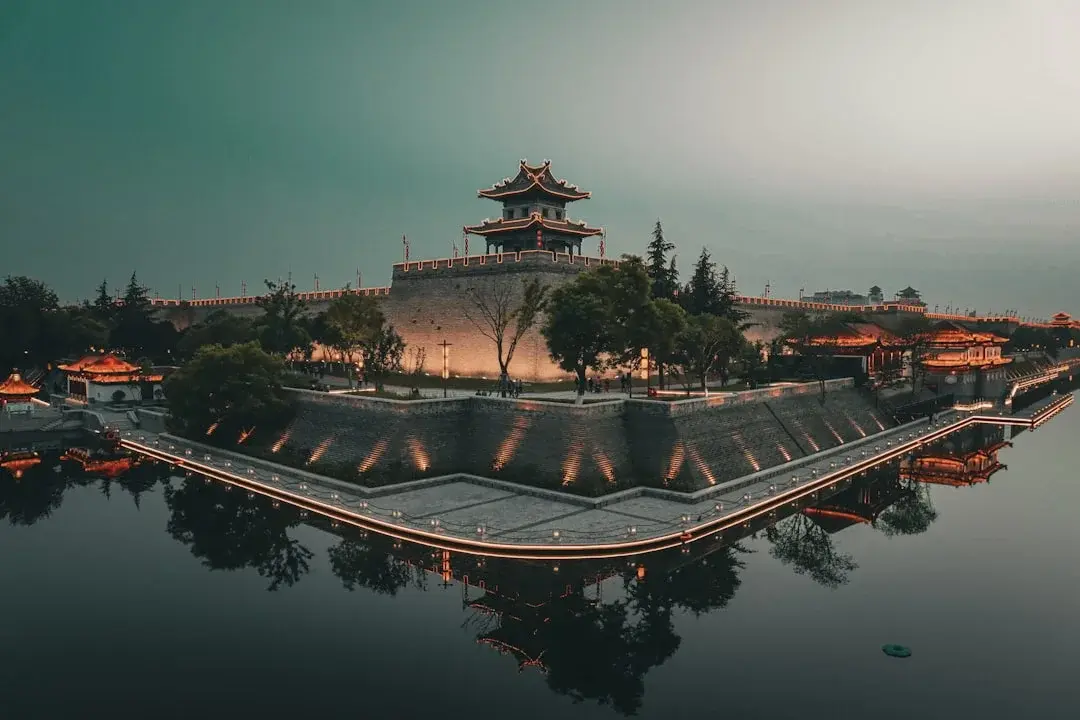
A complete 14 km rampart ringing the entire old town, wide enough on top to cycle — and the single best way to grasp the city's plan. Rent a bike at the South Gate (Yongningmen) and ride the full loop in roughly two to three hours, or simply walk a stretch near sunset when the light is on the watchtowers.
From up there the contrast is the point: bell towers and grey-tiled roofs inside the rectangle, glass towers immediately outside it. Very few Chinese cities let you circle their historic core this way; most lost their walls in the twentieth century.
Admission and bike hire are modest — around ¥54 entry and roughly ¥45 for a single bike or ¥90 for a tandem on a two-hour slot at last check (2025 pricing, verify before you go; rates and rental slots change seasonally).
Eat Through the Muslim Quarter (回民街)
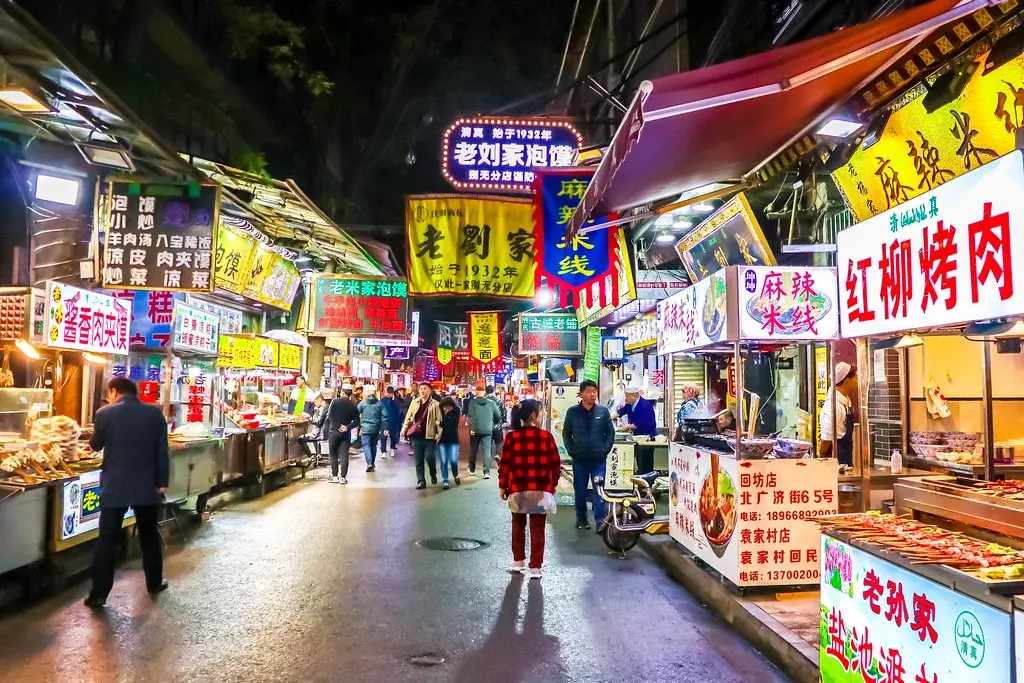
The historic Hui neighbourhood, and the direct living legacy of the Silk Road trade that made Chang'an cosmopolitan. It is a warren of lanes selling lamb skewers, hand-torn bread stews, sesame-oil, dried fruit and pomegranate juice.
The standard advice applies and is worth repeating: the main drag is heavily touristed, and the good eating is one or two lanes off it, wherever there is a local queue. Tucked behind the stalls is the Great Mosque — a serene complex built in Chinese courtyard style rather than with domes and minarets, and one of the quietest places in the old town.
Spend an Evening at the Big Wild Goose Pagoda and Tang Paradise (大雁塔)

Built in 652 AD to house the Buddhist scriptures the monk Xuanzang carried back from India, the pagoda anchors the best evening district in the city. The temple itself is calm during the day; the surrounding pedestrian streets and the Tang-themed Tang Paradise park come alive after dark, with a free fountain show and Tang-style architecture lit up.
This is the part of Xi'an that families and photographers tend to rate highest, and it's a useful counterweight to a day spent underground looking at clay soldiers.
See the Bell Tower and Drum Tower (钟楼 / 鼓楼)
The twin Ming towers marking the exact centre of the old town — floodlit at night and a reliable way to orient yourself. The Bell Tower sits on a roundabout within walking distance of the Muslim Quarter and most inside-the-wall hotels. A short visit rather than a destination, but the geography lesson is useful on your first evening.
Go Deeper at the Shaanxi History Museum and the Stele Forest
These two supply the context the Warriors alone can't. The Shaanxi History Museum holds a very large provincial collection — bronzes, Tang gold and silver, tomb frescoes — running from prehistory through the Tang. The Stele Forest is one of China's great collections of carved stone tablets, including classics cut in stone so they could not be corrupted by copying.
Both reward booking ahead; the history museum in particular is popular and issues timed slots.
Where Do the Terracotta Warriors Fit Into an Xi'an Trip?
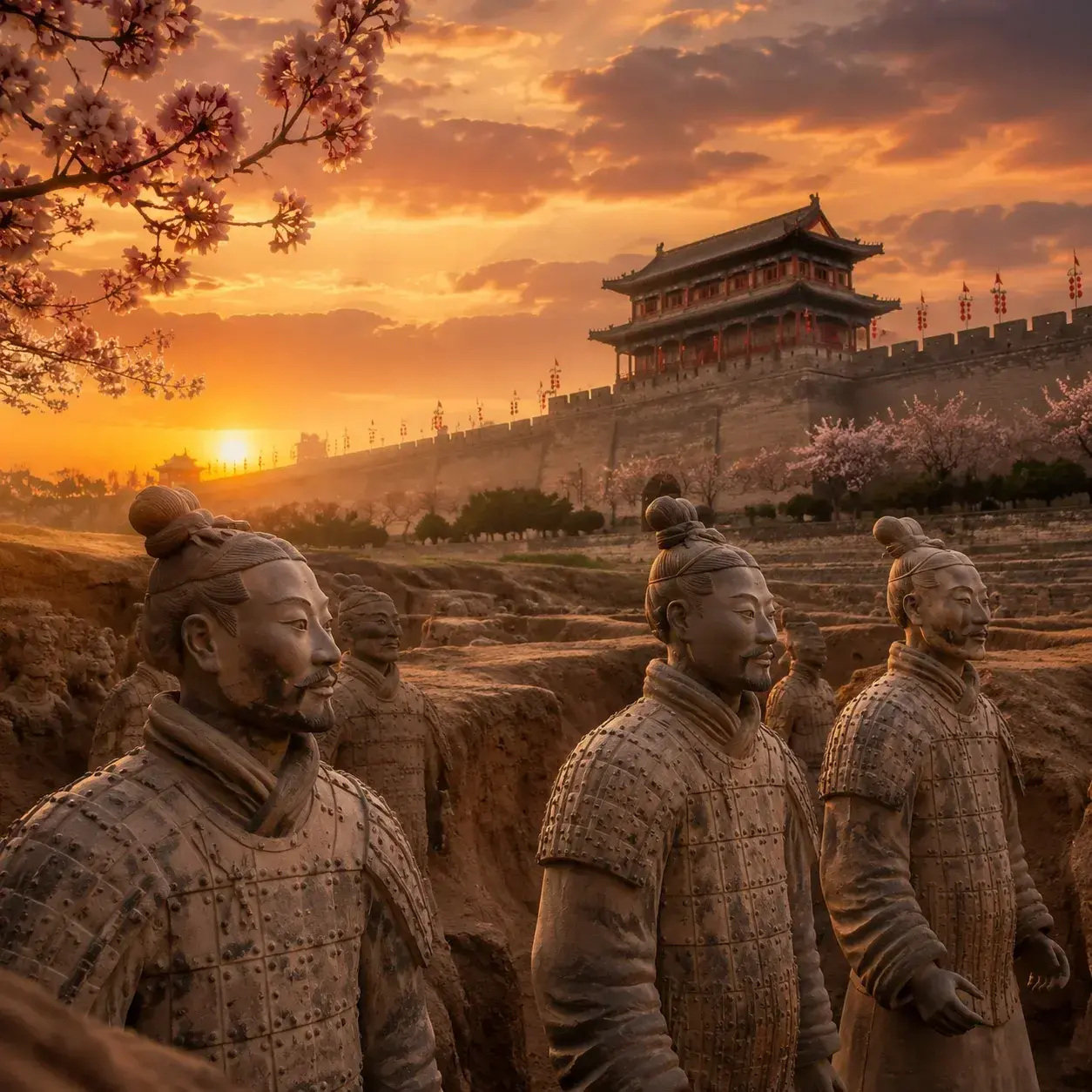
They're a half-day about an hour to ninety minutes east of the city, and they deserve to be the highlight of a balanced trip rather than the whole of it. Roughly 8,000 life-size clay soldiers, horses and chariots were made to guard the tomb of Qin Shi Huang, China's first emperor; farmers digging a well found them in 1974, and UNESCO inscribed the site in 1987.
The two mistakes visitors make are arriving mid-morning into the worst crowds, and walking the pits without any context — the rows mean far more with a guide or a good audio guide. Go at opening or from mid-afternoon, and consider seeing the pits in reverse order, finishing at the vast Pit 1 so it lands last.
Entry runs around ¥120 per person and slots are typically released about a week ahead under your real name (2025 figures, verify before booking). For the full decision — independent versus group versus private, timing, which pits, how long to allow — see the dedicated Terracotta Warriors guide.
An honest note: many travellers describe the Warriors as a "see it once" sight — genuinely astonishing, and over in two to three hours. That isn't a criticism; it's a planning fact. Build the rest of your days around the wall and the food and you'll rate the whole trip higher.
What Do Most Visitors Miss in Xi'an?
The ordinary city. Nearly every itinerary runs monument to monument and never touches the streets where Xi'an actually lives — which is a shame, because they're within walking distance of the same hotels.
Three that are worth your third day:
- The Wumu Gate (Little South Gate) morning market. Go early. This is a working neighbourhood breakfast market rather than a tourist attraction — steamed buns, soy milk, fried dough, vegetable stalls, and no English signage at all. - Daxue East Road and Taiyangmiaomen. Tree-lined streets near the university with independent coffee shops, gelato, small bistros and vintage clothing. The most reliable place in the city to recharge after a heavy morning of history. - Bingjiaoxiang and the surrounding alleys. Older residential lanes where the pace drops noticeably. Good for an aimless late-afternoon walk.
None of these will appear on a top-ten list, and that is precisely their value: they're where you stop looking at Xi'an as an artefact and start experiencing it as a city.
Beyond the Warriors: Xi'an's Other Imperial Tombs
If the first emperor's army left you wanting more, the Han Yang Ling Mausoleum is the better second stop and almost nobody goes. It's the tomb of Emperor Jingdi of the Han dynasty, and the experience is the opposite of the Terracotta site: you walk on glass floors directly above the excavation, looking down at thousands of miniature figures, livestock and household objects.
Where the Qin army projects military might, Han Yang Ling shows domestic life — which makes the pair genuinely complementary. It is also far quieter, which after a crowded morning at Pit 1 can be the more memorable of the two.
What Should You Eat in Xi'an?
Xi'an food is Silk Road food: wheat rather than rice, lamb rather than pork, and heavy on cumin and chilli. It's inexpensive, filling and unusually easy with children. You don't need a restaurant list so much as a shortlist of dishes to hunt down.
| Dish | What it is | Where to find it |
|---|---|---|
| Biang Biang noodles (biángbiáng面) | Wide, belt-like hand-pulled noodles in chilli and soy | Noodle shops citywide — the written character alone is a spectacle |
| Roujiamo (肉夹馍) | The original "Chinese hamburger": braised meat in a crisp flatbread | Muslim Quarter stalls and dedicated shops |
| Yangrou paomo (羊肉泡馍) | Mutton stew you finish yourself by tearing flatbread into the bowl | Sit-down places around the Muslim Quarter |
| Liangpi (凉皮) | Cold "cold-skin" noodles in a tangy, garlicky dressing | Street stalls; the best hot-weather option |
| Cumin lamb skewers (孜然羊肉串) | Charcoal-grilled skewers, heavy on cumin | Follow the smoke |
For a fuller breakdown of dishes, streets and how to order, see the Xi'an food guide.
Where Should You Stay in Xi'an?
Stay inside the walls near the Bell Tower for a first visit — central, walkable to the food, and well connected by metro. Pick elsewhere only for a specific reason.
| Area | Best for | Trade-off |
|---|---|---|
| Bell Tower / Drum Tower (inside walls) | First-timers, food access, walkability | Central and busy; lively at night |
| South Gate / Yongningmen (inside walls) | Wall cyclists, a slightly calmer base | Further from the Muslim Quarter |
| Big Wild Goose Pagoda / Qujiang | Evening streets, Tang Paradise, families | Outside the historic core; you'll use the metro |
| Near Xi'an North Station | One-night stops before an early train | Convenient, low on atmosphere |
Hotel names, room types and rates change constantly — confirm at the time of booking rather than relying on any figure you read months earlier.
When Is the Best Time to Visit Xi'an?
Target April–May or September–October: mild, dry and clear. Avoid high summer, when the city regularly reaches 35–40°C and outdoor sightseeing becomes a slog.
| Season | Conditions | Verdict |
|---|---|---|
| Spring (Mar–May) | Mild, roughly 12–25°C, dry, blossom in the parks | ✅ Best overall — aim for April or early May |
| Summer (Jun–Aug) | Hot and dry, often 35–40°C; peak domestic crowds | ❌ Early mornings and evenings only |
| Autumn (Sep–Oct) | Clear skies, roughly 15–25°C, the best light | ✅ A very close second |
| Winter (Dec–Feb) | Cold and dry, about −5 to 5°C, quiet and cheap | ➖ Fine if you layer; occasional snow on the walls |
Whenever you go, avoid the 1–7 October National Day holiday and Chinese New Year (late January to February). Domestic travel peaks in both windows and the Warriors are at their most crowded.
How Do You Get to Xi'an and Get Around?
Fly into Xi'an Xianyang International Airport (XIY) or arrive by high-speed rail, then use the metro, your feet and DiDi. The airport is around 40 km northwest of the centre; the Airport Express metro line reaches Xi'an North Station in roughly 30 minutes, and a taxi or DiDi into town takes about 45 to 60 minutes depending on traffic.
By rail, Xi'an is one of the best-connected cities in the country — roughly 4.5 hours from Beijing, about 3.5 hours from Chengdu, and around 1.5 hours from Luoyang, with services arriving at Xi'an North (西安北) and connecting to the old town on Metro Line 2. Times vary by service, so check current schedules. For booking mechanics and what to expect on board, see the China trains and transport guide.
Inside the walls, walking genuinely is the best option: the Bell Tower, Drum Tower, Muslim Quarter and the main gates all sit within about a twenty-minute radius. Off the metro lines, use DiDi — and set it up before you arrive.
Two practical points that catch foreign visitors out. Xi'an is effectively cashless, so link an international card to Alipay or WeChat Pay before you land; you'll use it for metro tickets and street food alike. And the major sites — the Terracotta Warriors and the Shaanxi History Museum in particular — require real-name, passport-linked reservations that regularly sell out several days ahead in summer.
How Many Days Do You Need in Xi'an?
Two to three days for a satisfying first visit. Add a fourth only for a day trip, or if you're continuing west along the Silk Road.
| Days | What fits |
|---|---|
| 1 day | Old town only — Bell Tower, Muslim Quarter, one stretch of wall, an evening at the pagoda |
| 2 days | The above plus the Terracotta Warriors, or a cultural show — workable but tight |
| 3 days | The full city: Warriors, the complete wall loop, Muslim Quarter, Shaanxi History Museum, Tang Paradise, and a morning in the local lanes — the pace we'd recommend |
| 4+ days | Add Mount Hua, Han Yang Ling or Famen Temple, or head west |
A workable three-day spine: Day 1 the Warriors in the morning, Bell and Drum Towers in the afternoon, Muslim Quarter for dinner. Day 2 cycle the wall early, Shaanxi History Museum after lunch, Tang Paradise and the pagoda at night. Day 3 the Wumu Gate morning market, then the coffee lanes around Daxue East Road, and Han Yang Ling if you still want more history.
With children: keep the Warriors short and guided, let the wall ride and Hanfu dress-up carry the fun, and put an evening at Tang Paradise in the middle so the trip isn't only museums.
Frequently Asked Questions
Why is Xi'an called China's ancient capital?
Because it served as the capital — under the name Chang'an — for thirteen dynasties across more than a thousand years, including the Han and Tang. It was also the eastern terminus of the Silk Road, which made it China's most internationally connected city for centuries.
Is Xi'an worth visiting beyond the Terracotta Warriors?
Yes. The complete 14 km Ming city wall, the Muslim Quarter's Silk Road food, the Tang-dynasty pagoda district and the Shaanxi History Museum each stand on their own. Most visitors who allow three days rate the wall and the food as highly as the Warriors.
How many days do you need in Xi'an?
Two to three. One day covers only the old-town centre; two adds the Terracotta Warriors; three lets you cycle the wall, eat properly, see the history museum and still spend a morning in the ordinary city without rushing.
When is the best time to visit Xi'an?
April–May and September–October — mild temperatures, dry air and clear skies. Avoid June to August, when heat regularly reaches 35–40°C, and skip the 1–7 October Golden Week and Chinese New Year, when domestic crowds peak everywhere.
Do you need to book Xi'an attractions in advance?
Yes for the major ones. The Terracotta Warriors and the Shaanxi History Museum both use timed, real-name reservations tied to your passport, and they sell out days ahead in summer. Smaller sights such as the city wall can usually be handled on the day.
Is Xi'an or Beijing better to visit?
They complement rather than compete. Beijing is the late-imperial capital — Forbidden City, Great Wall. Xi'an is the ancient one, an older layer of the same story. Most first-timers do both; the high-speed train between them takes about 4.5 hours.
Can you visit Xi'an without speaking Chinese?
Yes, though English is less common than in Beijing or Shanghai. Major sights and metro stations have English signage, and a translation app handles menus. Setting up mobile payment and DiDi before arrival removes most day-to-day friction.
Planning Your Xi'an Trip
Xi'an is the city that makes the rest of China legible. Give it two to three days, base yourself inside the walls near the Bell Tower, come in spring or autumn, see the Warriors early and with context, and leave real time for the wall, the Muslim Quarter and one unhurried morning in the ordinary lanes.
For the wider picture, start with the China travel guide, then read the Beijing travel guide to plan the classic pairing, or the Chengdu travel guide for a slower panda-and-teahouse contrast about three and a half hours south by rail.